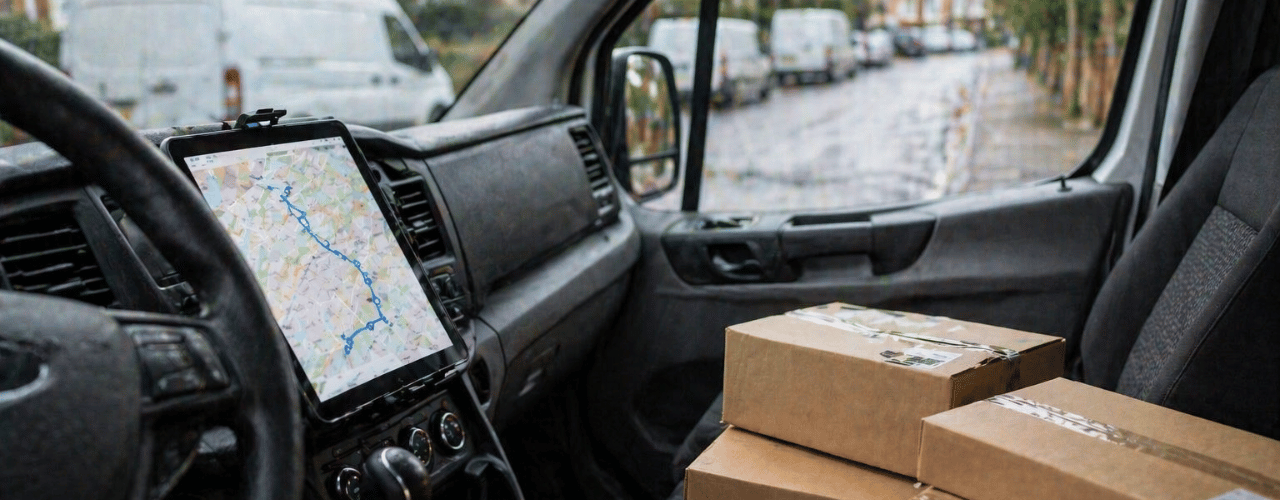

In the UK delivery trade, “dead mileage” is a direct hit on your take-home pay. Every mile you drive between drops without a parcel in your hand is an unpaid mile. If you aren’t sequencing your manifest with a professional postcode to postcode route planner, you’re almost certainly doubling back on roads you’ve already cleared. This “zigzag” effect turns a profitable shift into a loss-making exercise because it drains your tank and wears down your tyres for zero reward. By turning a chaotic list of addresses into a tight, logical loop, you stop donating your margins to the fuel pump and keep that cash in your business.
Why is my sat-nav creating “ghost miles” on my route?
You can solve the “ghost mile” problem by switching from commuter-grade maps to a database that understands UK road geography. UK postcodes are deceptive; our road networks, especially rural lanes and new-build estates, don’t follow a grid. Two postcodes that look like neighbours on a map might be separated by a railway line or a river, which turns a 200-yard gap into a four-mile detour.
Experienced drivers know that the price at the pump is only half the battle. The real maths is pence-per-mile. Commuter sat-navs that plan one stop at a time force you to cover distances that result in zero drops. For an owner-driver, that is pure unpaid labour. For a fleet manager, these empty miles across 20 vans create a massive monthly overhead that Delm8’s postcode to postcode route planner reduces dead mileage by ensuring the shortest road path is always the priority.
How do professional route planners compare to consumer apps?
The fastest way to improve your drop rate is to use a tool built for the 6:00 AM sorting belt reality. It’s easy to think a free navigation app is “good enough” until you’re fighting a 150-drop manifest with tools built for a Sunday drive. When looking for the best postcode to postcode route planner for couriers, you need to consider how the software handles specific logistical hurdles:
- The “Zigzag” Effect: Consumer apps plan point-to-point and often send you across a town centre twice. A professional planner builds a logical loop, so you never see the same junction twice. For a business, this reduces vehicle depreciation and extends the life of your brake pads and tyres.
- Postcode Centroids: Free tools drop a pin in the dead centre of a street. Delm8’s address finder identifies the exact doorstep. This removes the 3-minute “search crawl” at every stop, allowing a driver to handle an extra 5-10 parcels per shift without working longer hours.
- Fuel Consumption: High-mileage zigzagging drains your margins. Using a postcode to postcode route planner for multi drop deliveries can cut fuel spend significantly, with industry benchmarks suggesting savings of up to 20%. Lower fuel consumption directly improves your fleet’s carbon footprint and bottom-line profitability.
- Shift Length: Searching for addresses in the dark leads to burnout. Accurate planning removes the navigational guesswork. For managers, this translates to better driver retention and fewer “end of shift” accidents caused by fatigue.
How much fuel can a postcode to postcode route planner save?
Numbers don’t lie. Most drivers using a postcode to postcode route planner for delivery drivers report saving at least 5 miles of dead mileage every shift compared to manual planning.
On a standard 22-day working month, saving 5 miles a day totals 110 miles of saved driving. Based on average UK fuel costs for a mid-sized van, that is approximately £20 kept in your pocket every month. While £20 covers the cost of the Delm8 app, the real profit is the reclaimed time. Those 110 miles represent roughly four hours of driving time. You can use this time to take on higher-paying “premium” drops or reduce your operational overtime costs. If you want to see the specific impact on your overheads, you can calculate savings with postcode to postcode route planner software during a live audit of your current routes.
What is the difference between urban and rural dead mileage?
Savings depend on your “patch,” but the wasted miles hurt just as much whether you are in a city centre or a village:
- The Urban Shuffle: In cities like London or Birmingham, dead mileage relates to the “clog.” A postcode to postcode route planner reduces dead mileage by accounting for one-way systems and LTNs (Low Traffic Neighbourhoods) so you don’t drive three miles around a block to reach a door on the other side of a bollard. This prevents costly PCNs (Penalty Charge Notices) for drivers trying to “short-cut” through restricted zones.
- Rural “Wrong-Way” Detours: In the countryside, any postcode to postcode route planner case study UK focused will show that preventing a single detour down a narrow, mud-slicked country lane saves you 15 minutes of reversing. For a business, this protects your vans from the wing-mirror and bodywork damage common on tight rural routes.
How do I stop wasting money on delivery dead mileage?
You can reject the “zigzag” as a standard part of the job by taking control of your margins today. Finding real world savings with postcode to postcode route planner tools is the only way to remain competitive in a high-cost environment. Dead mileage is an optional expense that you don’t have to carry.
Delm8 was built by people who have stood in the rain at the depot and know the pressure of a high-volume manifest. We don’t just find the house; we find the shortest path to it. Ready to see exactly how much your fleet could save? Book a demo or download the Delm8 app today.