Commercial Fuel Cards in the UK: Are they worth it?

If you’re running a multi-drop courier business, diesel is easily one of your largest overheads. Between spiralling fuel prices at the pumps and tight delivery windows, finding ways to trim your running costs is essential for keeping your daily take-home pay healthy.
One tool that often comes up when drivers and fleet operators start chatting in the yard is the commercial fuel card. But looking past the glossy marketing pitch, how do they actually stack up from a practical and financial standpoint? Are they really cheaper than pulling up to your local supermarket forecourt? And are fuel cards actually worth the hassle?
After talking to plenty of drivers and digging into the numbers, we’ve concluded that the biggest win is usually operational rather than financial—meaning they help you sort out your tax invoices in one go and stop rogue fuel spending.
Types of Commercial Fuel Cards
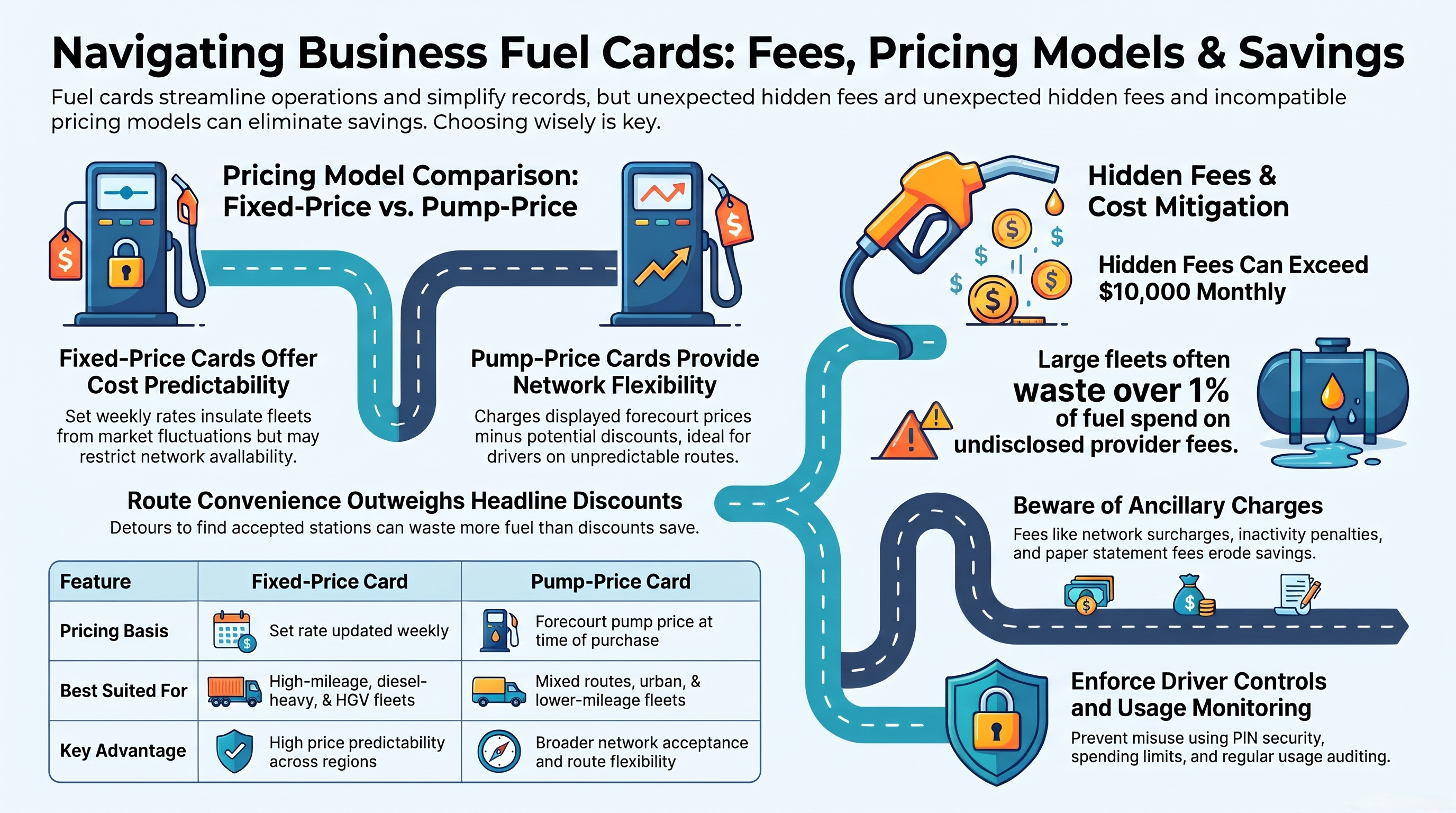
When you’re looking at getting a commercial fuel card, you’ve basically got to choose between two main pricing setups: pump-price models and fixed weekly wholesale pricing. Neither is a silver bullet; they’re built for different types of routes, vehicle sizes, and fuel needs.
Pump-Price Model
With a pump-price fuel card, you’re mainly paying whatever price is up on the forecourt board, though you might occasionally snag a modest discount or rebate somewhere between 0.5p and 2p per litre.
Because pump-price cards rarely save you a fortune per litre, the real value here comes from automated admin, stopping unauthorised spending, and getting one clean VAT bill at the end of the month.
Fixed Weekly Wholesale Pricing Model
Fixed weekly pricing completely cuts the cord with what’s happening on the retail forecourt. Every Friday afternoon, your fuel card provider sets a fixed wholesale price per litre (quoted without VAT) that kicks in on Monday morning across every participating station in their network. This rate tracks big wholesale market shifts—like Platts benchmark oil prices—rather than what local stations are charging.
The good news? Providers are usually flexible on this price. If you’re willing to haggle or you build a decent working relationship with your account manager, you can often push that price down further.
The Hidden Cost Landscape
A massive trap many drivers fall into comes down to how prices are quoted. Fuel card discounts and weekly rates are almost always quoted without VAT, whereas the board at the forecourt shows the price including VAT. Comparing an ex-VAT quote directly against a pump price makes it look like you’re saving a fortune. Once that 20% VAT lands, that gap shrinks fast.
On top of the VAT confusion, sneaky extra fees can eat away at your savings. Independent audits highlight four main types of charges you need to keep an eye on:
- Transaction and network service fees
- Convenience charges and non-core forecourt surcharges
- Account maintenance and plastic card issuance fees
- Low-volume penalties and inactivity fees
Are Fuel Cards Worth It? Fleet Segmentation & Break-Even Economics
Whether a fuel card makes sense for you depends entirely on your fleet size, monthly diesel volume, and how much admin you want to deal with. The maths changes completely depending on where you sit.
Tier 1: The Sole Trader and Micro-Fleet (1 to 2 Vehicles)
If you’re a sole trader running a single van or a trade sparky with a couple of motors, your direct pence-per-litre savings are going to be pretty tiny.
Imagine you’re burning 300 litres of diesel a month. A 3p per litre discount gives you a gross monthly saving of £9.00. But if your provider charges a £12.00 monthly account fee plus a 40p transaction fee across six fills (£2.40), you’re actually ending up £5.40 out of pocket every single month.
For micro-operators, a fuel card only makes sense if:
- It’s fee-free: There are zero annual fees, no monthly account charges, and no transaction surcharges.
- It saves you admin headaches: You value keeping business fuel completely separate from your personal account, dodging the nightmare of chasing paper receipts, and sorting your HMRC VAT returns with a single official statement.
Tier 2: The SME Commercial Van Fleet (5 to 20 Vehicles)
For growing courier businesses and regional delivery teams, fuel cards start delivering proper, measurable returns. At this volume, saving hours on admin and stopping fuel fraud outweighs a small shift in pump prices.
Let’s look at a typical mid-sized setup:
- Fleet Profile: 15 commercial diesel vans.
- Monthly Usage: 8,525 litres (averaging 55 litres per fill across 155 top-ups).
- Card Deal: Multi-network card giving a 3p per litre wholesale discount against national averages.
- Fees: 40p transaction fee per fill; £12.00 monthly account fee.
Here’s how the monthly numbers shake out:
- Gross fuel discount: 8,525 litres × £0.03 = £255.75
- Transaction surcharges: 155 fills × £0.40 = -£62.00
- Account platform fee = -£12.00
- Net monthly cash saving = £181.75 (£2,181.00 a year)
On top of saving over two grand a year on fuel, you’re also clawing back about 4 hours a month that used to be wasted digging through crumpled paper receipts and cross-checking bank statements. Value that at an admin rate of £18 an hour, and you’re saving an extra £864 annually. Plus, locking those cards down to diesel only means nobody’s sneaking a meal deal or screen wash onto the company tab.
Tier 3: Logistics, Haulage, and Heavy Goods Vehicles (HGVs)
If you’re running heavy haulage or a fleet of HGVs, fuel cards aren’t optional—they’re core infrastructure. A 50-vehicle HGV fleet with 400-litre tanks filling up twice a week can easily chew through 160,000 litres a month.
At that kind of scale:
- A 3p wholesale discount nets you £4,800 a month—nearly £58,000 a year.
- Fixed card fees become totally negligible.
- Bunker network access (like Keyfuels or Shell CRT) gets your trucks onto high-speed commercial pumps with bulk AdBlue, cutting down precious queue time.
- The digital transaction trail helps back up your vehicle locations for compliance audits and driver hours monitoring.
| Fleet Category | Monthly Volume | Main Benefit | Net Savings | Verdict |
|---|---|---|---|---|
| Sole Trader (1 Van) | Low (200–500L) | Tax separation & clean VAT records | Low/Negative if fees apply | Conditionally Worth It (Go zero-fee) |
| Small Fleet (2–4 Vans) | Moderate (600–1,800L) | Admin cut & Direct Debit control | £15–£50/month net | Worth It (Admin & spending caps) |
| SME Fleet (5–20 Vans) | High (2,500–12,000L) | Fraud control & wholesale discounts | £1,500–£4,000+ net annual | Highly Worth It |
| Heavy Haulage (20+ HGVs) | Massive (40k–200k+ L) | Bunker pricing & tachograph support | £15k–£70k+ net annual | Essential |
Strategic Procurement Playbook: Six Rules for Fleet Owners
Before you sign up with a fuel card provider, keep these six golden rules in mind to protect your bottom line:
- Check your actual routes before looking at network size: Don’t get blinded by claims of “national coverage.” If a driver has to detour two miles off their delivery route just to find an approved station, the extra fuel and wear-and-tear will wipe out any 4p-per-litre savings instantly. Stick to networks that match where your vans are actually driving.
- Work out the total cost of ownership: Ask for a full list of all secondary charges before you sign anything so you can accurately calculate your net savings.
- Haggle if you’re on a weekly pricing contract: Check your weekly price and ring up your provider to push for a better rate. Don’t just accept what they hand you—if you call them up regularly, they will usually drop the price. They’re banking on you being too busy to check.
- Lock down product restrictions: Make sure each card is pinned to the right vehicle type (e.g., standard diesel for vans) to block expensive premium fuels, car washes, and random shop snacks.
- Audit your invoices every week: Treat your weekly statement like a proper bill check. Look out for surprise convenience fees, non-network surcharges, paper statement charges, or cheeky add-ons like auto-enrolled carbon offsetting.
- Future-proof for electric vans: If you’re planning to introduce electric vans over the next couple of years, look for a provider that can handle both diesel and public EV charging on a single HMRC-compliant invoice so you don’t end up juggling multiple apps and systems later.
Conclusion: The Final Verdict
Fuel cards aren’t a magic wand for cheap motoring. If you’re a sole trader doing low mileage, an expensive card loaded with monthly maintenance fees is just going to drain your profits for no good reason. In those cases, a fee-free option is the only way to go.
However, if you’re running five or more vehicles, a well-chosen fuel card is a proper business asset. When you match it to your actual routes and stay sharp on hidden fees, it saves you money, cuts out hours of tedious admin, handles your VAT effortlessly, and keeps your entire fleet running tight and profitable.