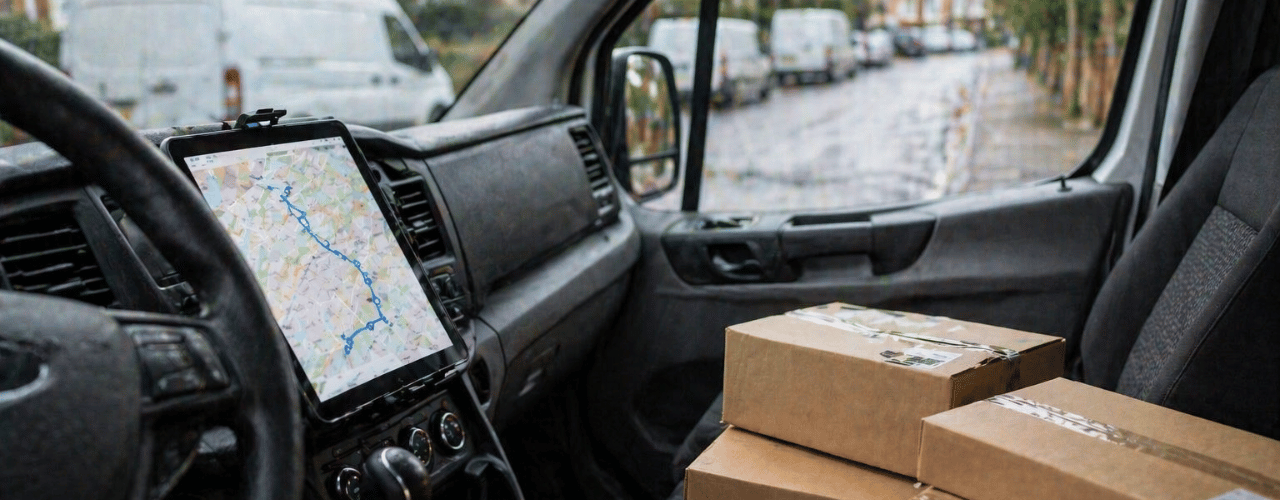

Fuel is the most visible cost in last-mile delivery. Inefficient routing creates a silent “labour leak” that drains capital faster than the pump. Every mile driven in the wrong sequence adds unpaid minutes to a shift. It directly erodes the profitability of a 100-drop manifest. Professional route optimisation turns a chaotic pile of parcels into a logical circuit. It protects your fuel tank and your hourly rate.
In the UK, fuel savings rely on maintaining momentum. Delm8 eliminates the “search crawl” and the “U-turn fatigue” found in standard maps. Tighter sequencing generates these gains. Stop driving slower through a patch. Start driving smarter.
Why the shortest route often costs the most in fuel
Basic navigation tools default to the shortest distance between two points. Distance is a shallow metric when you work against a ticking clock and a 3.5-tonne weight limit. A route that appears two miles shorter on paper often forces a van into a congested town centre or onto a single-track rural road during the school run. True multi-drop route optimisation accounts for the physical reality of the road. It bypasses the “dead miles” spent in traffic and ignores the reversing out of tight lanes that consumer apps incorrectly identify as through-roads.
A fully loaded van at 8:00 AM acts differently than a near-empty one at 4:00 PM. A bulkhead full of heavy cargo demands significant energy to move; it resists stopping and makes turning difficult. Efficient routing tackles the heaviest loads and the most fuel-consuming “stop-start” sections while the vehicle carries its maximum weight. Dragging that weight across unnecessary miles at the end of the day is a waste of energy that hits your bottom line.
How much fuel does a route planner save per drop?
Logistics savings are never a fixed percentage. Your “patch” dictates the maths. A high-density urban route saves fuel by reducing “stop-start” crawl. Route optimisation for rural deliveries provides value by eliminating the 10-mile navigational errors that occur when a single postcode covers several different hamlets.
- Fewer Navigational Errors: Using a UK address finder with precise property lookup prevents the “missed turn” on a narrow country road. You avoid the five-mile detour just to find a safe place to turn the bulkhead around.
- Increased Drop Density: Effective route optimisation for delivery routes allows a driver to fit 120 stops into a fuel budget previously reserved for 100. This lowers your cost-per-drop immediately.
- Reduced Idle Time: Every minute the engine runs while you remain stationary is a zero-MPG activity. Sequencing stops to avoid fighting across oncoming traffic keeps the wheels turning. Profit stops evaporating out of the exhaust.
These marginal gains protect your profit margins against fluctuating pump prices. They improve your drop-per-hour (DPH) rate which is the only metric that matters when you reconcile the week’s earnings.
The hidden fuel drain: The “Double-Burn” of failed deliveries
A failed delivery is a fuel theft you rarely see on a spreadsheet. When a driver marks a parcel as “Address Not Found” because they couldn’t find a hidden farm gate or an unmapped new-build, that fuel is gone forever. You then have to burn more fuel to drive back to the depot, and even more to attempt the same delivery the following day.
In the trade, this is known as the “Double-Burn.” It is the most expensive mile you will ever drive. By using doorstep-accurate navigation, you ensure that every mile of fuel burnt results in a successful drop. This level of precision makes sure your fuel investment actually buys you a completed manifest.
Can route optimisation reduce vehicle maintenance costs and wear?
Fuel is only one of many fluids you save when you sequence a route correctly. Constant “emergency” braking to catch a missed turning wears down tyres and brake pads. Heavy acceleration to make up for lost time destroys your clutch. Deploying the best route optimisation for drivers protects the physical asset of the van.
When you use specialist route planning solutions, you remove the “handbrake stress” of searching. Drivers who aren’t frustrated by vague map pins drive smoothly and make fewer mistakes at the end of a long shift. For fleet managers, route optimisation serves as a preventative maintenance strategy. It keeps vans on the road and out of the body shop, which reduces the frequency of expensive service intervals.
Is a route optimisation app for couriers worth the monthly cost?
The cost of an app is negligible compared to the cost of “lost capacity.” If a driver spends twenty minutes a day backtracking or fighting a messy sequence, they lose twenty minutes of earning potential. Route optimisation for multiple stops ensures every mile on the odometer is a “productive mile” contributing to a completed delivery.
Delm8 builds for the “Final 100 Feet” of the UK road network. We provide accurate property data to ensure your route optimisation holds up when you pull up to the kerb. This eliminates the inefficient rerouting that happens when a driver marks a difficult house as “Address Not Found” because of sheer frustration.
Stop donating your margins to the fuel pump. Book a 60-minute live demo and reclaim your profit.