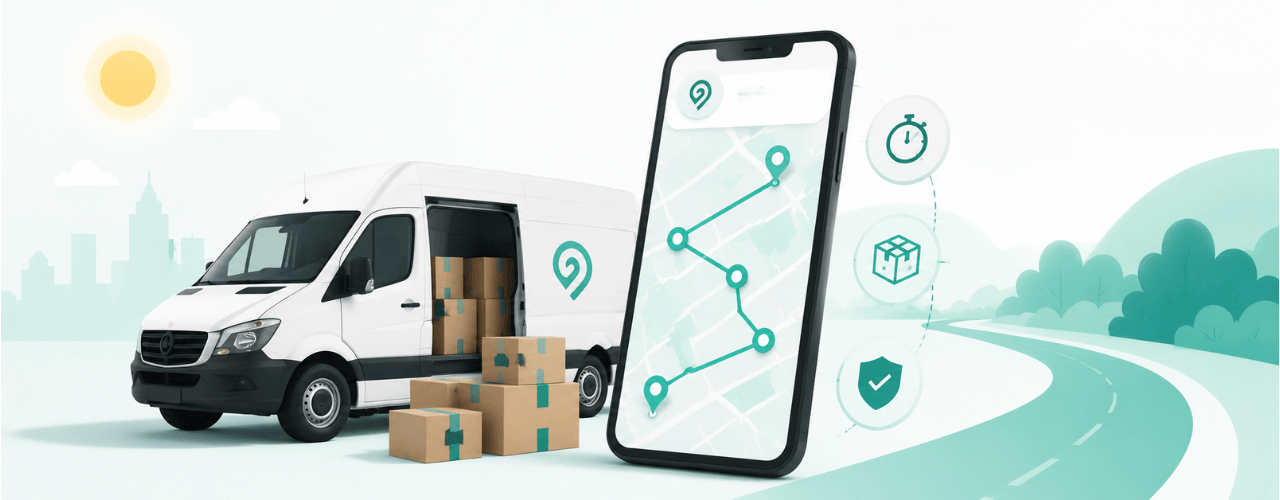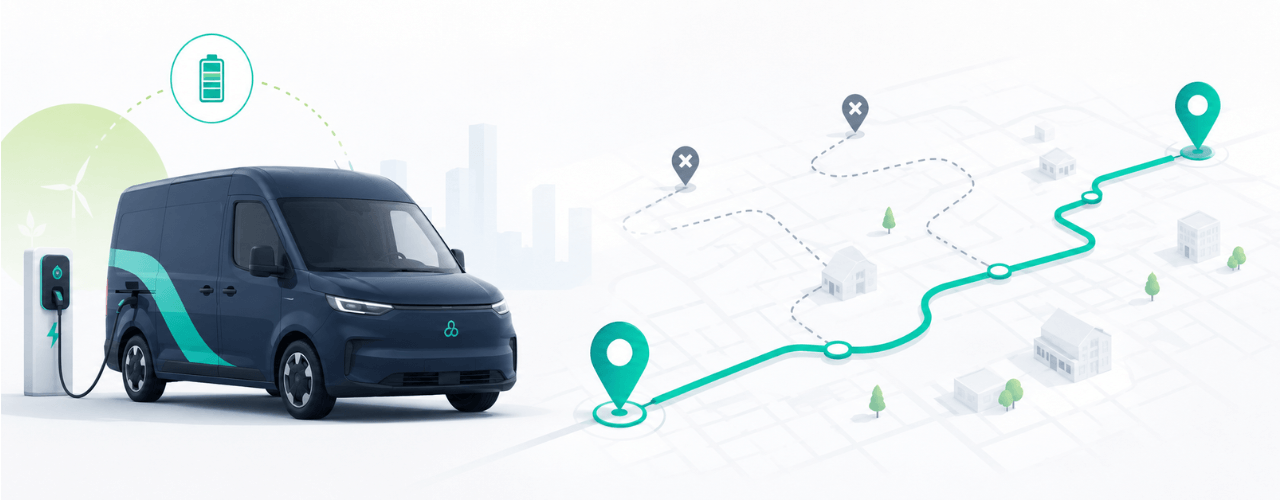

Transitioning to electric vehicles (EVs) is a legal mandate in the UK. Clean Air Zones (CAZ) and London’s ULEZ are expanding. For these environments, a professional route planner for low emission delivery fleets is a fundamental piece of hardware. Planning for an EV fleet requires a total departure from internal combustion engine (ICE) logic. Distance is a shallow metric. Energy density takes its place.
For owner-drivers and small fleets, a smart route planner for electric vans closes the gap between an optimistic manufacturer range and the punishing reality of a UK multi-drop shift.
How much range does an electric delivery van lose in winter?
Expect to lose between 30% and 40% of your total range when the temperature drops. Battery chemistry slows down in the cold. It’s that simple. When you’re scraping ice off the windscreen at 6:00 AM, the temptation to blast the cabin heater is high. Do it, and you’ve burnt through your first 10 miles of range before the wheels even turn.
A professional route planner for battery range optimisation stays pessimistic to keep you safe. It treats ambient temperature and payload weight as non-negotiable variables. An e-Transit stuffed with heavy parcels demands significantly more kilowatts per mile than an empty van heading back to the depot. Getting the energy cost of every turn right keeps your deliveries predictable. It stops the administrative nightmare of a van stranded on a dual carriageway.
Avoiding the £130 “Searching” Fine (PCN Prevention)
A messy van creates hidden costs like the Penalty Charge Notice (PCN). When you are stressed and hunting for a box, your eyes are in the back of the van instead of on the road signs. This distraction makes it far more likely you will roll into a “School Street” restriction or a new LTN camera.
Knowing exactly where the parcel is before you enter a restricted zone keeps your head outside the van and focused on the cameras. Using an EV route planner for delivery drivers UK ensures you find parcels faster. More importantly, you keep your hard-earned money out of the council’s pockets.
Why “Mental Mapping” fails on high-volume routes
Many drivers still rely on “Mental Mapping” by trying to remember every box location or marking them with a Sharpie. Sharpie ink fades in the rain. Labels get covered by other heavy poly-bags during the shift. If you are loading at a major hub like DPD, EVRi, or Amazon, the belt doesn’t stop for you to write on every box.
A digital system is the only way to scale. Unlike a permanent marker, an electric vehicle route planner for multi drop deliveries doesn’t get buried or smudged. It gives you “X-ray vision” through the bulkhead even when the sun goes down and you are working by the light of a phone torch.
Small Vans vs. Long Wheelbase (LWB): The Space Struggle
The search struggle changes depending on your vehicle. In a small van like a Citroen Berlingo, space is the enemy. Everything is stacked on top of each other and the “lost” parcel is always at the very bottom. In a LWB Sprinter or Transit, the enemy is the “walk-around” time.
Having to walk from the cab to the rear doors only to realise the parcel was near the side-loading door is a massive waste of energy. A route planner for electric delivery vans that maps parcels in the van levels the playing field. Whether you are cramped in a small car-derived van or walking the length of a 3.5-tonne Luton, knowing the exact “Zone” saves your knees and your clock.
Why is “Pre-conditioning” essential for electric van routes?
Pre-conditioning warms the battery and the cabin while the van is still plugged into the depot charger. You draw energy from the grid, not your precious battery. Lithium-ion batteries have a “sweet spot” between 15°C and 35°C. Starting a shift with a cold battery is a waste of power; you spend energy just to reach an operating temperature.
The best route planner for electric fleets uses a “Payload Gradient.” You sequence the heaviest drops at the start of the route. The van gets lighter as the day goes on, reducing the torque needed for the final few miles. These thermal and weight strategies protect the battery’s state of health (SoH). For a business owner, this maintains the long-term asset value of the van and prevents premature battery degradation.
The Routing Shift: ICE vs. EV Priorities
- Primary Goal: Traditional routing chases the shortest distance. Smart EV routing prioritises the lowest energy consumption.
- Topography: ICE maps often ignore elevation. EV planning weights uphill and downhill sections to account for battery drain and regenerative braking gains.
- Payload Dynamics: Professional EV software treats payload as a dynamic variable. It sequences drops to lighten the van early, reducing the torque required for the rest of the shift.
- Environmental Factors: Ambient temperature is irrelevant to a diesel engine but a high-priority variable for battery range.
Where can I find EV charging points for large delivery vans in the UK?
Finding a charger is easy. Finding one that fits a 3.5-tonne Luton or a Long Wheelbase (LWB) Sprinter is a battle. Most public infrastructure was designed for small cars. These chargers sit in multi-storey car parks with 2.0m height limits or narrow bays that leave your rear doors hanging out into traffic.
An EV delivery route planner with charging points understands the physical dimensions of a commercial vehicle. It filters for “pull-through” or van-accessible bays. This prevents “kerbside search” that drains a dwindling battery. For the driver, this removes the stress of navigating tight car parks. For the fleet manager, it keeps the van on the road rather than stuck at an inaccessible charger.
How does regenerative braking improve multi-drop route efficiency?
Regenerative braking turns the stop-start friction of urban traffic into a power source. Motorways are the enemy; they drain batteries quickly due to constant high speeds. The city is where the EV wins. Every time the driver lifts off the accelerator, the motor acts as a generator.
A route planner with EV charging stops sequences your day to squeeze every drop of “regen” out of the route. We keep you in high-density urban clusters where the battery effectively recharges itself between drops. This ensures that high-speed A-roads only appear when the battery is in its “Goldilocks” zone.
The Delm8 Edge: Precision as a Power Source
The most wasteful thing an EV can do is search. Every minute spent circling a block because a map pin is 50 yards off the doorstep is energy you won’t get back. Delm8 provides coordinate-level accuracy. We eliminate the ghost miles of the final 100 feet.
Using route planner for sustainable last mile delivery tools cuts the idle time that bleeds a battery dry. This precision usually adds an extra 5–10 drops per charge. You increase your profitability without buying a larger, more expensive battery.
Stop wasting watts. Protect your margins. Check your route density against the professional standard or download the Delm8 app today.