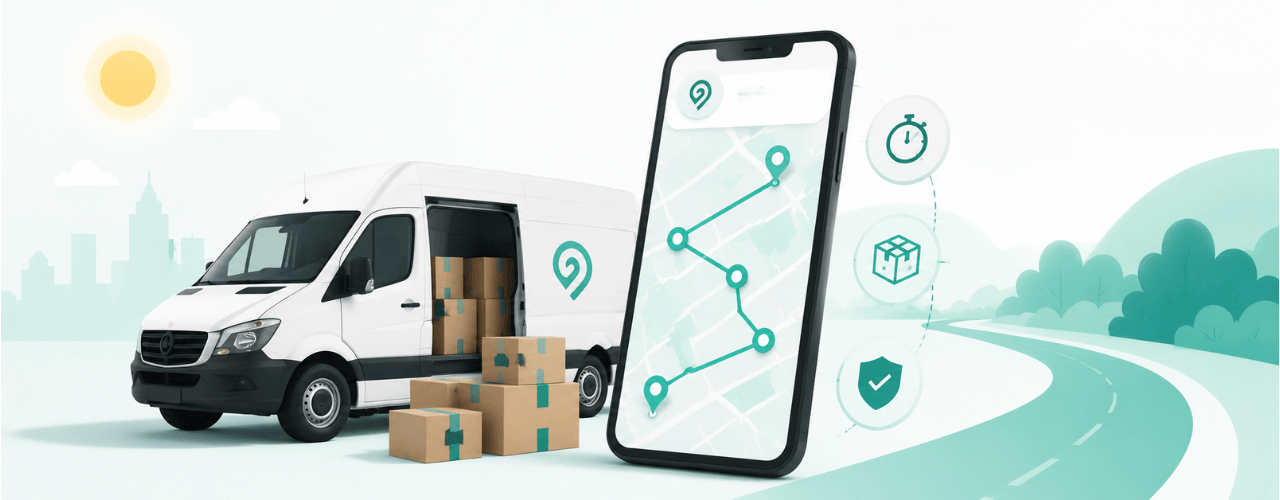

Same-day delivery compresses route planning from a background task into a time‑critical operation that leaves little margin for correction once the day starts.
The pressure sits with the systems that organise routes. Many teams feel forced to trade certainty and recoverability for speed when relying on a route organiser app alone.
Many operators rely on a route organiser app to keep daily work manageable. These tools bring order to multi‑stop schedules and help drivers make sense of busy days. As same-day volumes rise, that same tool can start to slow things down.
The sections below focus on where route planning holds up and where delivery teams lose control.
What Is a Route Organiser App Designed to Do Well?
A route organiser app exists to bring structure to busy delivery days. At its core, it focuses on organising stops into a workable order.
Used correctly, it can help by:
- Grouping deliveries into a logical sequence
- Reducing unnecessary backtracking
- Giving drivers a clear view of their planned stops
- Supporting consistent daily workflows
For many businesses, this provides a noticeable improvement. Drivers spend less time deciding where to go next, and planners gain confidence that routes make sense.
This works in stable delivery environments where volume and timing stay predictable. Problems appear when demand accelerates and planning time shrinks.
Where Do Route Planning Challenges Appear in Same-Day Delivery?
The route organiser app bottleneck for same-day delivery does not appear because the tool fails at its job. It appears because the job itself has changed.
Under rapid turnaround conditions, planners work against compressed timelines. They must build routes quickly, often while vehicles load and drivers prepare to leave. Small delays in preparing routes can cascade into missed delivery slots later in the day.
Common pressure points include:
- Increased time spent preparing routes as volumes spike
- Manual adjustments to fix issues that software cannot anticipate
- Planning queues forming while drivers wait to leave
In these moments, route organisation turns reactive rather than supportive, as planners divert attention from optimisation to keeping the day on track. Instead of enabling speed, the process slows as teams try to force static plans into fast‑moving conditions.
How Does a Route Organiser App Cope with Rapid Delivery Growth?
A common question from operations managers is how a route organiser app copes with rapid delivery growth. It performs as well as the data and preparation allow.
When daily stops double, the app still sequences them. When delivery areas expand, the app still orders addresses. The challenge lies in what the app does not control.
Rapid growth exposes operational issues such as:
- Incomplete or unclear address details
- New delivery areas that drivers do not recognise
- Less time to review and sense‑check routes
As volume increases, planners rely more heavily on automation. That reliance magnifies the impact of any weak inputs. If address data lacks precision, the resulting route may look efficient but fail in practice.
Growth does not create these issues. It exposes them earlier in the day, when recovery options narrow.
What Same-Day Delivery Challenges Can’t a Route Organiser App Fix?
Same-day delivery logistics introduce challenges that sit outside route sequencing. A route organiser app focuses on order, not certainty.
Key challenges include:
- Hard-to-find properties such as rural homes, new builds, or named locations that lack clear access points or consistent map placement
- Inconsistent address formats across customer orders
- Drivers losing time searching for the correct destination
- Increased stress when schedules leave no margin for error
In these cases, even a well-ordered route can break down. A driver who spends ten minutes locating one address may miss several others. The app did its job, yet the delivery still fails.
Route planning depends on confidence that teams can reach each stop quickly and correctly, because uncertainty at any stop affects every one that follows.
Why Isn’t a Route Organiser App Enough for Same-Day Delivery?
Route organisation answers the question, “In what order should I visit these locations?” It does not answer whether that order remains workable once drivers encounter access issues, unclear destinations, or delays earlier in the route. Same-day delivery also demands answers to, “Can I find these locations without delay?” and “How much uncertainty exists at each stop?”
Without accurate address resolution, route plans stay theoretical. Drivers may follow the sequence perfectly and still lose time searching for entrances, gates, or unnamed properties.
In fast delivery models, planning accuracy often matters more than optimisation, because once a route slips mid‑day, teams struggle to regain lost time. A tool that organises routes without addressing address precision leaves a gap that drivers must fill on the road. For many teams, the first practical step to closing that gap is resolving address certainty before routes are built. Tools such as Delm8 are designed to do exactly that, giving planners confidence in destination accuracy before routes are finalised, rather than expecting drivers to absorb that risk during delivery.
How Can Delivery Teams Optimise Routes in High-Velocity, Same-Day Markets?
In high-velocity, same-day markets, optimisation depends on how routes perform once they leave the screen and meet real‑world conditions. The goal shifts from planning routes faster to reducing friction before drivers set off.
Effective teams focus on:
- Improving address accuracy before routes are built
- Reducing last-minute decision-making for drivers
- Preparing for variability rather than reacting to it
- Supporting drivers with clear, reliable destinations
In this setup, teams keep the route organiser app central. It provides structure and order. Its impact increases when teams pair it with reliable address information that removes uncertainty from each stop.
The result is smoother execution, with teams choosing routes that hold together under real conditions. Drivers spend more time delivering and less time correcting issues that planning did not anticipate.
How Can Address Accuracy Reduce Same-Day Delivery Pressure?
Delm8 addresses one of the most persistent causes of delay in same-day delivery: uncertainty at the point of arrival, where time pressure peaks.
Delm8 is designed to help teams locate UK properties that standard postcode searches often struggle with. This includes farms, flats, new housing developments, and named locations. By confirming precise destinations before routing begins, Delm8 reduces the risk of drivers losing time on arrival.
For same-day delivery operations, this means:
- Reduced time spent searching at each stop
- Greater confidence in tight delivery windows
- Less reliance on local knowledge under pressure
- Better use of route organiser apps already in place
Delm8 works alongside the navigation tools that drivers already use. It supports preparation without adding complexity or forcing changes to established workflows.
Is Same-Day Delivery Creating a New Route Planning Bottleneck?
Yes, same-day delivery is creating a new bottleneck. Delivery demands have changed faster than planning practices, even though route organiser apps still perform their intended role.
Route organisation remains essential, but teams now judge it by how well plans survive contact with the day. It no longer guarantees success in high‑speed delivery environments on its own. Accuracy and preparation now matter as much as speed when delivery windows are tight.
If same-day delivery is putting pressure on your planning process, you can speak to the Delm8 team to review how address accuracy fits into your current setup.