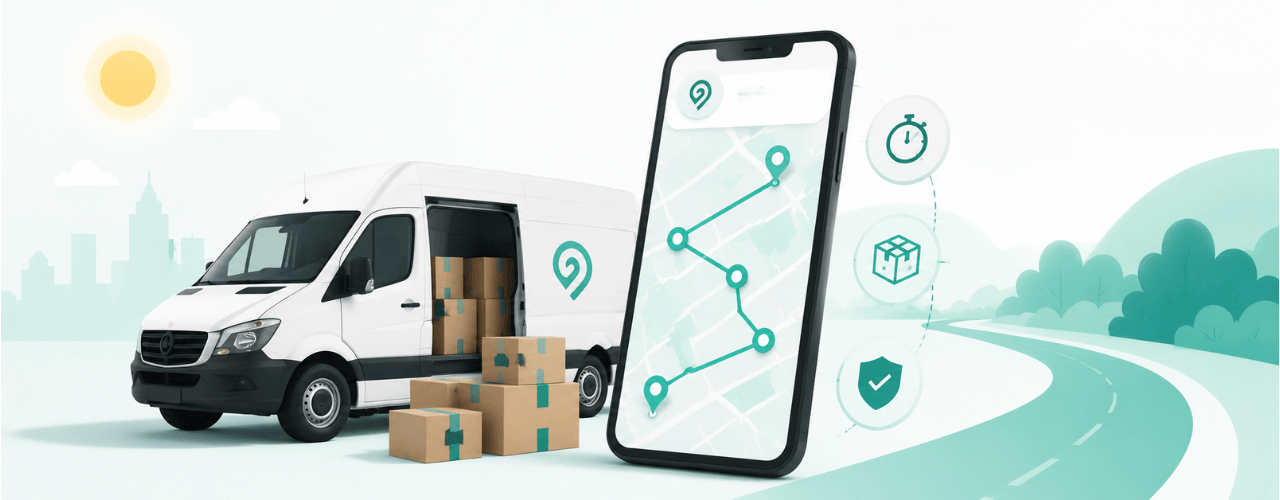

Type in a list of postcodes, tap a button, and a neat route appears in seconds. On the surface, a Postcode to Postcode Route Planner feels simple, but under the hood it converts postcode lists into coordinates, reads the road network and applies optimisation to organise daily routes.
How Postcodes Become Coordinates in a Postcode to Postcode Route Planner
A postcode is not a single spot. It usually covers a group of addresses. In dense urban areas, that might be a short street or a block of flats. In rural areas, it can span a long road, several farms or scattered homes.
A route planner cannot work with a vague area. It needs a coordinate for each stop. Many systems use a centroid approach, placing a point that represents the “centre” of that postcode unit and passing that point into the routing engine.
If that centroid sits in the wrong place, guidance may get drivers close rather than to the right gate or driveway. In towns and cities, a single postcode for a block of flats or a mixed-use street creates the same issue. The postcode gets the van near the building, but not necessarily to the correct entrance.
More advanced tools use internal address data, building footprints and entrance points to shift that default location towards the true delivery point. That is where a Postcode to Postcode Route Planner starts to behave more like a property-level navigation tool. For a business, that shift from “somewhere in the postcode” to the right gate or entrance is what cuts wasted minutes at each stop and keeps drivers moving instead of calling in for directions.
How a Postcode to Postcode Route Planner Uses Geocoding to Interpret Each Stop
Before a route planner can draw a line on the map, it must understand the text you give it. That is the role of geocoding. Geocoding turns a string such as “AB12 3CD” or “Farmhouse, Long Lane, AB12 3CD” into coordinates and a standardised address record the system can use.
The aim is simple: each stop should represent the place where the driver actually needs to park and walk. When those locations are right first time, planners see fewer failed deliveries on the board and drivers stop losing ten minutes here and there hunting for the correct entrance.
Mapping Data: The Road Network, Speed Profiles and Turn Logic
Once every stop has a coordinate, the Postcode to Postcode Route Planner needs to understand how those points connect. That is the job of the road network model.
Inside the software, the network is a graph made up of nodes and links. Nodes represent junctions or key points along a road. Links represent the stretches of road between those nodes. Each link carries attributes such as road type, typical speed range, one-way rules, turn bans and size limits.
When you ask an urban delivery Postcode to Postcode Route Planner to suggest a route, it uses this network to simulate the journey. It considers legal turns, junctions and typical travel times. In city areas, this network has to capture bus gates, pedestrian zones, timed access and restricted loading bays. Outside towns, longer stretches between postcodes matter more than constant junction turns. Getting that network right means route plans line up more closely with what drivers actually experience on the road, instead of optimistic timings that fall apart once vans leave the depot.
If your team is wrestling with complex postcode lists, speak with Delm8 about how you plan routes today.
The Routing Engine: How It Calculates the Most Efficient Path
Because the coordinates and road network are already in place, the optimisation engine can trust the map and focus on the best order to visit each stop.
With coordinates and a road network in place, the Postcode to Postcode Route Planner can start its work. For a single journey from one postcode to another, the planner solves a shortest path problem. It searches the network for the fastest or shortest path from the start node to the end node.
For a multi-stop route, the problem changes. The system is no longer finding one path, but the best order in which to visit a list of stops. That is similar to the classic travelling salesperson problem, where the aim is to visit every location once and keep overall distance or time as low as possible.
In real delivery operations, there are extra rules. Drivers may not return to the start. Certain stops must be visited early or late in the day. Vehicles have capacity limits, or different routes start from different depots. Once you introduce fleets and micro-hubs, the problem moves closer to the vehicle routing problem, which has to design routes that drivers can complete within their shift without constantly overrunning.
An exact mathematical solution takes too long to compute when you have dozens of stops across many postcodes. That is why a Postcode to Postcode Route Planner relies on heuristics and smart search methods. It builds good routes quickly by trying promising combinations, swapping the order of stops and applying rules that reflect delivery priorities.
How Micro-Hubs Change Postcode-to-Postcode Routing
Micro-hubs add a new level. Micro-hubs replace one large depot with several smaller hubs closer to delivery zones, each serving a group of postcodes and the last mile legs that sit within them.
A Postcode to Postcode Route Planner for micro-hubs has to solve two questions at once. First, it must assign stops to the right hub. Second, it must plan efficient short routes from each hub to the stops in its area. The assignment step considers distance, travel time and capacity at each hub. The routing step uses the same engine described above, but on a smaller, focused set of stops. Micro-hub delivery route optimisation postcode to postcode often values balance and predictability, so teams aim for compact routes that fit within a shift.
In city centres, an urban delivery route planner between postcodes may handle several micro-hubs inside one city, each serving specific postcode groups. The engine has to avoid overlapping zones, reduce cross-traffic between hubs and respect local loading and timed access rules. Done well, that keeps vans close to their drops, reduces empty miles between postcodes and makes it easier to hit tight urban time windows.
Scaling Up: How a Postcode to Postcode Route Planner Handles Fleet Delivery at Volume
When you scale from one or two routes to a full fleet, the same technology has to decide which driver should cover which postcodes and stops, given shift times, vehicle constraints, preferred territories and micro-hub boundaries. It then builds a set of routes that share the workload fairly and make sense on the ground. In practice, that means each driver sees a route with a manageable number of stops and realistic travel times. For operations teams, that means a shift plan that is easier to brief, easier to monitor and less likely to produce surprise overtime – learn more about our corporate packages.
Why Property-Level Accuracy Still Matters in a Postcode-Based System
Even in a system that works postcode to postcode, the final metres of each journey still matter. A route that guides a driver to the middle of a postcode area is not good enough for reliable last mile performance.
A last-mile Postcode to Postcode Route Planner therefore adds extra layers of information on top of basic postcode mapping. It stores access points, building entrances, service yards and typical stopping spots. It recognises named houses, farms and small trading estates that share a postcode but need different approach routes. This is where tools in the same category as Delm8 stand out. They do not stop when they convert a postcode to a centroid on the map. They combine postcode logic with property-level intelligence, so each pin on the route represents the place where the driver actually needs to be. That difference looks small on a map, but across a full day of drops it can be the gap between drivers finishing on time and routes that constantly overrun.